1. Introduction: Moving Beyond the Ears
If you are living with a persistent ringing or whistling, you are likely all too familiar with the frustration of an "alarm nobody else can hear." Consider the story of Gerald, a 58-year-old retired Army staff sergeant. For four years, Gerald logged every spike and pitch in a notebook, searching for a pattern that never emerged. Gerald felt that his ears were failing him.
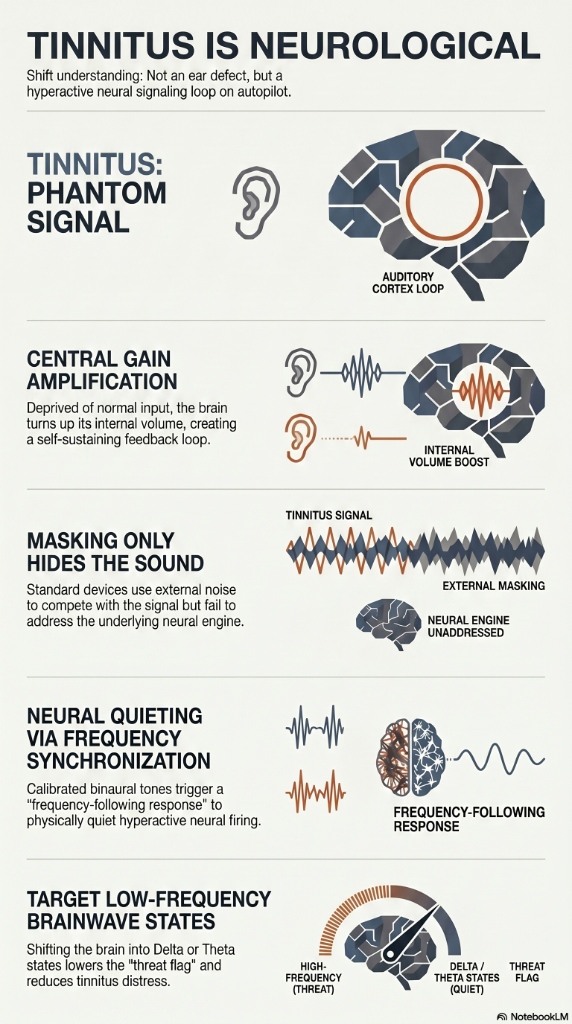
However, the central insight of modern neuro-auditory science is that chronic tinnitus is rarely a permanent ear defect. Instead, it is a hyperactive neural signaling loop that the brain has learned to run on autopilot. While the journey may start in the ears, the sound you hear now is being generated by the brain itself.
"The ringing isn't coming from your ears… What's generating the signal now is your brain. Specifically, a process called central gain amplification — where your auditory cortex, deprived of its normal input signal, literally turns up its own internal volume to compensate."
— NeuroTinn Editorial TeamTo find relief, we must stop looking at the ears as the "active generator" and start understanding the hidden neurological process that keeps the signal alive.
2. The Ear-Brain Connection: Origin vs. Generator
To manage tinnitus effectively, we must distinguish between the initial trigger and the persistent signal. Auditory hair cells act as the entry point, but they are not the source of the ongoing sound.
| Feature | The Initial Trigger (The Ears) | The Persistent Signal (The Brain) |
|---|---|---|
| Role | Entry point for sound and initial site of cellular damage. | The "active generator" that produces the phantom sound. |
| Mechanism | Reduced input due to damaged hair cells. | Hyperactive neural firing in the auditory cortex. |
| Practical Focus | Damage Mitigation | Signal Modulation |
The original damage to those delicate hair cells is usually triggered by one of the following:
- ·Loud noise exposure (such as Gerald's military service)
- ·The natural process of aging
- ·Medication or vascular changes
When these cells stop sending clear information, it creates a "silence vacuum." To compensate, the brain initiates a specific biological response to fill the void.
3. Deep Dive: What is Central Gain Amplification?
When the brain is deprived of sound, it doesn't remain passive. It performs an "adaptive response" known as Central Gain Amplification.
Think of your auditory cortex as having an internal volume knob. When the ears are damaged and the input signal drops, your brain tries to "hear" what it's missing by turning that volume knob all the way up. This increase in the spontaneous firing rates of neurons creates the "phantom signal" — a sound that exists entirely within your neural pathways.
This increased volume doesn't just stay in the auditory cortex; it eventually connects to the centers of the brain that govern our emotions and stress levels.
4. The Limbic System: Why It Gets Louder Under Stress
The reason tinnitus feels so intrusive is due to the Limbic System — the brain's "threat detector." When a sound never stops, the limbic system flags it as a potential danger. This triggers a loop involving high cortisol and the sympathetic nervous system, which keeps the brain in a state of "high alert."
- 01The Phantom Signal (The Sound)The initial neural noise from central gain amplification.
- 02The Threat Flag (The Limbic Response)The brain identifies the sound as a danger, causing stress and anxiety.
- 03The Amplification (Increased Volume)High stress levels cause the brain to focus more intensely on the signal, making it louder and harder to ignore.
If the brain can learn to turn the volume up in response to stress and perceived threats, can we teach it to turn the volume back down?
5. Shifting the State: The Science of Neural Quieting
Traditional masking devices merely drown out the sound with external noise. To achieve lasting relief, we must use a Neural Quieting Response to interrupt the loop from the inside. This is made possible by the Frequency-Following Response (FFR) — the brain's natural tendency to synchronize its electrical activity with external rhythmic pulses.
We use the "math of the brain" to achieve this. For example, if we deliver a 250 Hz tone to your left ear and a 252 Hz tone to your right ear, your brainstem perceives the difference: 2 Hz. This is the Delta frequency. This is not a metaphor — it is measurable, electroencephalography-confirmed neurophysiology.
By guiding the brain into specific states, we can quiet hyperactive firing:
| Brainwave State | Frequency | Primary Benefit |
|---|---|---|
| Delta | 2 Hz | Sleep: Helps quiet hyperactive firing for deep, restorative rest. |
| Theta | 6 Hz | Meditation: Reduces the "threat flag" response and limbic distress. |
| Alpha | 10 Hz | Relaxation: Lowers stress and calms the sympathetic nervous system. |
| Beta | 20 Hz | External Focus: Helps you concentrate on work instead of the ringing. |
6. Conclusion: A New Perspective on Relief
The path to silence requires a shift from "masking" to "interrupting." While masking devices simply compete with the phantom signal, neurological approaches match the brain's own language to lower the internal volume.
Relief comes when we stop treating the ears and start communicating with the brain. By using neuroplasticity to provide the brain with the "quiet" signals it craves, we can teach the neural loop to settle, moving the tinnitus from the center of your life back into the background where it belongs.
You have the ability to rewrite your neural pathways. By matching your routine to your neurology and using it consistently, you can reclaim control over your internal volume knob and break the cycle of the phantom signal.
Ready to turn the volume back down?
Neurotinn puts the Neural Quieting Response protocol into a precision binaural therapy tool — calibrated to the exact frequencies described in this article. Lifetime access, $47.